RNA Marker 1000
2025-12-11
Epstein-Barr Virus (EBV) Nucleic Acid Detection Kit (Real-Time PCR Method)
2025-12-16Yeast Transformation Kit (Saccharomyces cerevisiae)
Product Number: YTK001
Shipping and Storage
Stored at -20℃, valid for at least one year. Except for Carrier DNA, it is stored at 4℃ and valid for 3 months. DMSO can also be stored at room temperature.
Component
| Component | 50T |
| Buffer A | 105mL |
| Buffer B | 5mL |
| Buffer C | 30mL |
| Carrier DNA | 500μL |
| DMSO | 3.6mL |
Description
Our company's Competitive Cell Preparation and Transformation Kit for Saccharomyces Cerevisiae is a rapid, convenient, and efficient kit for preparing highly active brewing yeast competent cells and performing plasmid transformation. This kit provides almost all the reagents required for the preparation and transformation of competent cells, except for the culture medium, without the need for dilution and preparation. The operation is simple and fast, and the preparation of competent cells can be completed within 30 minutes after yeast cultivation. It can be used for yeast hybridization experiments and yeast library construction experiments. When transforming brewing yeast, use the buffer solution provided in the reagent kit to culture yeast cells in the state to be transformed. Then mix the competent cells with the plasmid DNA and carrier DNA to be transformed, and incubate them with the transformation solution for transformation. Carrier DNA is a short linear single stranded DNA that promotes the entry of plasmids into yeast cells during the uptake of exogenous plasmid DNA, and also protects plasmids from degradation by DNA enzymes.
Saccharomyces cerevisiae is a single celled eukaryotic microorganism belonging to the genus Saccharomyces and the species Saccharomyces cerevisiae. Saccharomyces cerevisiae is a widely studied and used eukaryotic model with a genome of approximately 1.2 × 10⁷bp. The nucleus contains 16 chromosomes and approximately 6000 ORFs, with only 4% of yeast genes having introns and a simple genetic background. Brewing yeast has growth characteristics similar to prokaryotes, making it easy to cultivate and perform genetic operations. It is a model eukaryotic organism, known as the "Escherichia coli" of eukaryotes. Brewing yeast can exist in a haploid state, making it easier to perform genotype phenotype analysis and efficient homologous recombination, making it easy to edit genome sequences for high-throughput genetic analysis. The expression system of brewing yeast has a certain degree of post-translational processing ability when expressing exogenous genes. The harvested exogenous proteins undergo folding processing and glycosylation modification to a certain extent, which is beneficial for maintaining protein activity and stability. Moreover, exogenous genes can be secreted and expressed in brewing yeast, and the secretion of expressed products outside the cell is not only beneficial for purification, but also avoids the accumulation of large amounts of products inside the cell.
During the transformation of brewing yeast, appropriate plasmids can be selected based on the nutritional deficiency type mutations of the strain. Generally speaking, if specific components of the culture medium (amino acids, purines, or pyrimidines) are lacking, mutant strains cannot grow. Using plasmids complementary to the mutant gene of the strain can enable the transformant to grow on the culture medium lacking specific components. Usually, transforming 1µg plasmid can produce>103 transformants, and the transformation efficiency may vary among different strains of brewing yeast.
Please refer to Figure 1 for the transformation effect of using our company's brewing yeast competent cell preparation and transformation kit.
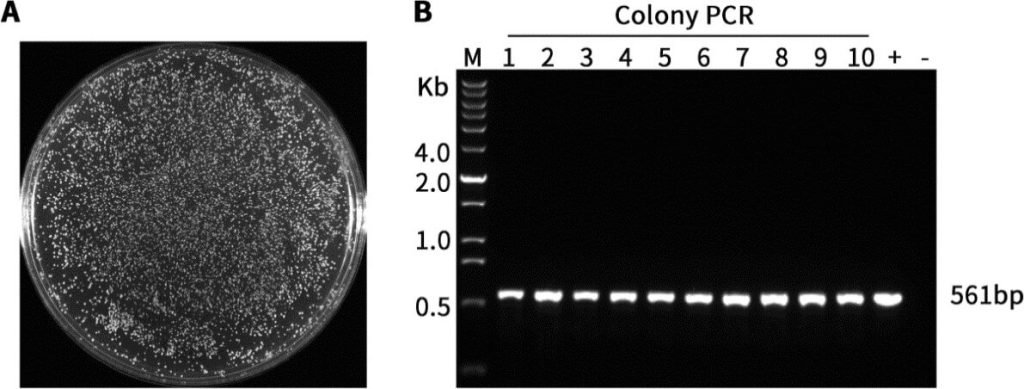
The transformation effect diagram of Yeast Transformation Kit (Saccharomyces cerevisiae).
A. After 48 hours of cultivation in pGAL1,10-α factor-MCS-His-MCS-Flag URA vector using yeast INVSc1 competent cells prepared using Yeast Transformation Kit (Saccharomyces cerevisiae), plates were prepared. B. The colony in Figure A was subjected to electrophoresis using D7279 yeast colony PCR kit (enzymatic hydrolysis) after colony PCR. Mix 1μg of plasmid DNA and 10μL of heat denatured Carrier DNA, and add them to 100μL of competent cells prepared using this kit. Gently tap the bottom of the tube with your fingers and mix well; Add 600µL Buffer C and incubate in a 30℃ water bath for 30 minutes. After incubation, add 70µL DMSO and gently mix up and down. Incubate in a 42℃ water bath for 15 minutes, then immediately incubate in an ice bath for 3-5 minutes. Centrifuge at room temperature of approximately 12000-14000g for 10 seconds, discard the supernatant, gently add 100µL Buffer A and resuspend the bacterial cells. Finally, coat all onto nutrient deficient medium plates without Uracil and invert at 30℃ for 2-3 days until a single colony appears. Subsequently, PCR validation was performed using the D7279 yeast colony PCR kit (enzymatic hydrolysis). 561bp is the amplification band of the target gene fragment. M, DNA Ladder. 1-10, experimental group (PCR template is yeast single colony lysate),+, positive control; -Negative control. The actual usage effect of this product may vary due to differences in experimental conditions, materials, etc. The effects shown in the picture are for reference only.
This kit can be used multiple times, and small and medium packages can be prepared and used for competent cells that can undergo 50 and 250 transformations, respectively.