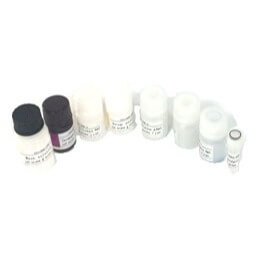
Human Herpesvirus 6 (HHV-6) ELISA Kit (Qualitative)
2026-05-13Bovine Viral Diarrhea Virus(BVDV Ab) ELISA Kit (Qualitative)
2026-05-13Bovine Viral Diarrhea Virus (BVDV) ELISA Kit (Qualitative)
Product Number: ELK063
Shipping and Storage
- Reagent kit storage: 2-8℃.
- Validity period: 6 months.
Component
| Component | 96T |
| 30× concentrated wash buffer | 20mL×1 |
| Enzyme conjugate | 6mL×1 |
| Microplate (Coated) | 12 wells×8 strips |
| Sample diluent | 6mL×1 |
| Chromogen substrate A | 6mL×1 |
| Chromogen substrate B | 6mL×1 |
| Stop solution | 6mL×1 |
| Positive control | 0.5mL×1 |
| Negative control | 0.5mL×1 |
Description
This kit uses a double antibody sandwich enzyme-linked immunosorbent assay (ELISA) to detect bovine viral diarrhea virus (BVDV) in specimens. Using purified bovine viral diarrhea virus (BVDV) antibodies coated on a microplate, solid-phase antibodies can be prepared that can bind to the viral diarrhea virus (BVDV) in the sample. After washing to remove unbound antigens and other components, they can then bind to HRP labeled viral diarrhea virus (BVDV) antibodies to form antibody antigen enzyme-linked antibody complexes. After thorough washing, TMB substrate is added for color development. TMB is converted to blue under the catalysis of HRP enzyme and to the final yellow under the action of acid. Measure the absorbance (OD value) at a wavelength of 450nm using an enzyme-linked immunosorbent assay (ELISA) reader, and compare it with the CUTOFF value to determine the presence or absence of bovine viral diarrhea virus (BVDV) in the specimen.
Application
This kit is used to detect the level of viral diarrhea virus (BVDV) in bovine serum, plasma, and related liquid samples.
Specimen requirements
- Serum: Blood naturally coagulates at room temperature for 10-20 minutes, centrifuge for about 20 minutes (2000-3000 revolutions per minute). Carefully collect the supernatant. If precipitation occurs during storage, centrifuge again.
- Plasma: EDTA or sodium citrate should be selected as anticoagulants according to the requirements of the specimen. After mixing for 10-20 minutes, centrifuge for about 20 minutes (2000-3000 rpm). Carefully collect the supernatant. If sediment forms during storage, it should be centrifuged again.
- Urine: Collect with a sterile tube and centrifuge for about 20 minutes (2000-3000 rpm). Carefully collect the supernatant. If sediment forms during storage, centrifuge again. Refer to the implementation for pleural effusion, ascites, and cerebrospinal fluid.
- Cell culture supernatant: When detecting secreted components, collect them using sterile tubes. Centrifuge for about 20 minutes (2000-3000 rpm). Carefully collect the supernatant. When detecting intracellular components, dilute the cell suspension with PBS (pH 7.2-7.4) to a cell concentration of around 1 million/ml. By repeatedly freezing and thawing, cells are destroyed and intracellular components are released. Centrifuge for about 20 minutes (2000-3000 rpm). Carefully collect the supernatant. If precipitation forms during storage, it should be centrifuged again.
- Tissue specimen: After cutting the specimen, weigh it. Add a certain amount of PBS, pH 7.4. Quickly freeze and store in liquid nitrogen for future use. The specimen remains at a temperature of 2-8℃ even after melting. Add a certain amount of PBS (pH 7.4) and homogenize the specimen thoroughly by hand or using a homogenizer. Centrifuge for about 20 minutes (2000-3000 rpm). Carefully collect the supernatant. After packaging, one portion is to be tested, and the rest is to be frozen for future use.
- Extract the specimen as soon as possible after collection, according to relevant literature, and conduct experiments as soon as possible after extraction. If the experiment cannot be conducted immediately, the specimen can be stored at -20℃, but repeated freezing and thawing should be avoided.
- Samples containing NaN3 cannot be detected because NaN3 inhibits the activity of horseradish peroxidase (HRP).