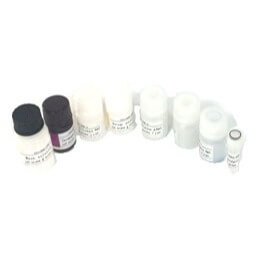
DNA Methylation Kit
2026-05-12Human Parvovirus B19 ELISA Kit (Qualitative)
2026-05-12AFB1-LYS adduct
Product Number: ELK05J0094
Shipping and Storage
Store at 2-8℃, away from light and moisture. Validity period: 6 months.
Component
| Component | 96-Well Configuration | 48-Well Configuration |
| Microplate | 8 holes×12 strips | 8 holes×6 strips |
| Standards | 0.3mL×6 pipes | 0.3mL×6 pipes |
| Sample diluent | 6mL | 3mL |
| HRP-Conjugated Detection Antibody | 6mL | 3mL |
| 20×washing buffer | 25mL | 15mL |
| Substrate A | 6mL | 3mL |
| Substrate B | 6mL | 3mL |
| Stop solution | 6mL | 3mL |
| Plate Sealer | 2 sheets | 2 sheets |
Note: The concentrations of standard samples (S0-S5) are 0, 50, 100, 200, 400, and 800ng/mL, respectively.
Description
This AFB1-LYS ELISA kit is intended Laboratory for Research use only and is not for use in diagnostic or therapeutic procedures.The Stop Solution changes the color from blue to yellow and the intensity of the color is measured at 450 nm using a spectrophotometer. In order to measure the concentration of AFB1-LYS in the sample, this AFB1-LYS ELISA Kit includes a set of calibration standards. The calibration standards are assayed at the same time as the samples and allow the operator to produce a standard curve of Optical Density versus AFB1-LYS concentration. The concentration of AFB1-LYS in the samples is then determined by comparing the O.D. of the samples to the standard curve.
Specimen requirements
- Serum: Use a serum separator tube and allow samples to clot for 30 minutes before centrifugation for 10 minutes at approximately 3000×g. Remove serum and assay immediately or aliquot and store samples at -20℃ or -80℃.Avoid repeated freeze-thaw cycles.
- Plasma: Collect plasma using EDTA or heparin as an anticoagulant. Centrifuge samples for 30 minutes at 3000×g at 2-8℃ within 30 minutes of collection. Store samples at -20℃or -80℃. Avoid repeated freeze-thaw cycles.
- Urine, pleural and ascitic fluid, cerebrospinal fluid, and saliva: Collect using sterile tubes, centrifuge at 2-8°C for 20 minutes (3000 rpm). Carefully collect the supernatant or store at -20°C or -80°C for future use. However, repeated freeze-thaw cycles should be avoided.
- Cell culture supernatant: Collect using sterile tubes, centrifuge at 2-8°C for 20 minutes (3000 rpm), carefully collect the supernatant, or store at -20°C or -80°C for later use. However, repeated freeze-thaw cycles should be avoided.
- Animal tissue samples: Wash the tissue with pre cooled PBS (0.01M, pH=7.4) to remove residual blood, weigh and cut the tissue into small pieces. Mix the shredded tissue with the corresponding volume of PBS (usually in a weight to volume ratio of 1:9, for example, 1g of tissue sample corresponds to 9mL of PBS, the specific volume can be adjusted appropriately according to experimental needs, and records should be kept. Recommend adding protease inhibitors to PBS and grinding thoroughly on ice (at low temperature) in a glass homogenizer. Alternatively, grinding can be performed in a tissue grinder. If further lysis of tissue cells is required, the homogenate can be sonicated and finally centrifuged at 5000×g for 10 minutes at 2-8℃. The supernatant can be collected for testing. For other tissue samples that are not thoroughly homogenized in a glass homogenizer or tissue grinder, they should be thoroughly ground in liquid nitrogen.
- Plant tissue samples: Wash the tissue with pre cooled PBS (0.01M, pH=7.4) to remove residual soil, pesticides, etc. After weighing, cut the tissue into small pieces. Mix the shredded tissue with the corresponding volume of PBS (usually in a weight to volume ratio of 1:9, for example, 1g of tissue sample corresponds to 9mL of PBS, the specific volume can be adjusted appropriately according to experimental needs, and records should be kept. Recommend adding protease inhibitors to PBS and grinding thoroughly on ice (at low temperature) in a glass homogenizer. Alternatively, grinding can be performed in a tissue grinder. If further lysis of tissue cells is required, the homogenate can be sonicated and finally centrifuged at 5000×g for 10 minutes at 2-8℃. The supernatant can be collected for testing. The supernatant should be divided into single doses and stored at -20℃ or -80℃, avoiding repeated freezing and thawing.
- Cell sample: Animal cells: For adherent cells, gently wash the cells with an appropriate amount of pre cooled PBS and separate them by trypsin digestion. Collect cells by centrifugation at 1000 ×g for 5 minutes (suspended cells can be directly collected by centrifugation). Discard the supernatant and wash the cells three times with cold PBS. Resuspend cells in cold PBS at a concentration of 1 × 10⁷ cells/mL. Use an ultrasonic disruptor to thoroughly break down cells, causing them to break down and release intracellular components. Centrifuge at 2-8℃ for 20 minutes (3000 rpm), then carefully collect the supernatant for testing; Plant cells: Dilute the cell suspension with PBS at pH 7.2-7.4 to achieve a cell concentration of around 1 million/ml, place it on an ice box, and use an ultrasonic disruptor to thoroughly crush the cells. Centrifuge at 2-8℃ for 20 minutes (3000 rpm), carefully collect the supernatant for testing.
- Throat swab: Add 2mL of PBS with pH 7.2-7.4, dissolve the head of the throat swab, shake well, use tweezers to remove the throat swab and squeeze the liquid dry. Centrifuge at 2-8℃ for about 20 minutes (2000-3000 rpm), and carefully collect the supernatant. Pack one portion for testing, freeze the rest for later use. If sediment forms during storage, centrifuge again before loading for testing.
Extract specimens as soon as possible after collection, and conduct experiments as soon as possible after extraction. If the experiment cannot be conducted immediately, the sample should be used within 6 days when it can be stored at 2-8℃. Otherwise, it must be stored at -20℃ (≤ 1 month) or -80℃ (≤ 2 months), and repeated freezing and thawing should be avoided. If precipitation forms during storage, it should be centrifuged again before sample testing. Samples containing NaN3 cannot be detected because NaN3 inhibits the activity of horseradish peroxidase (HRP).